
Rotator Cuff Healing Index (RoHI): Predicting Healing Success After Repair
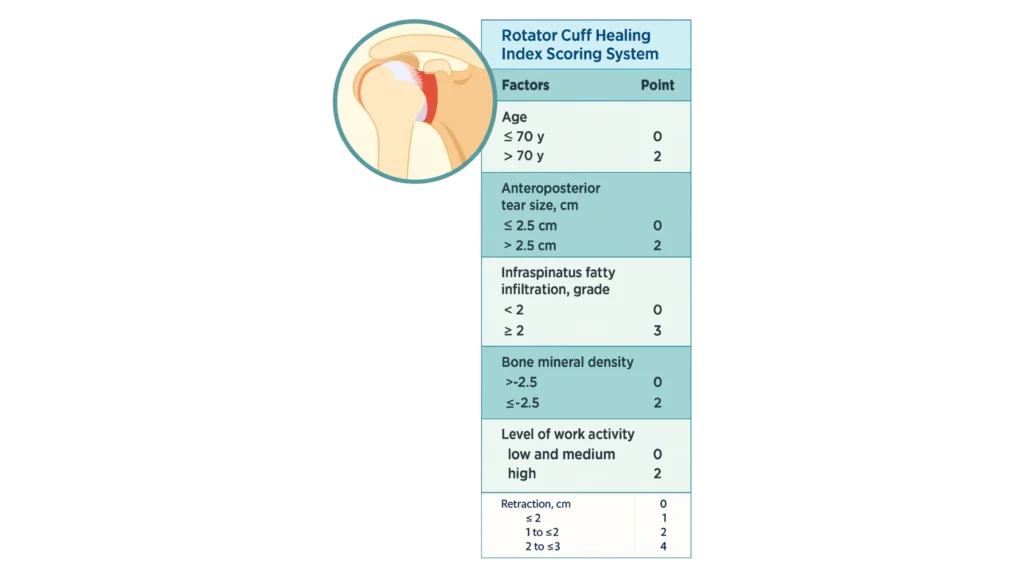
Understanding the Rotator Cuff Healing Index (RoHI) Rotator cuff repair remains one of the most performed yet unpredictable procedures in orthopedics. Despite surgical advances, retear rates still range widely, from under 20% to over 50% depending on patient factors. To better anticipate outcomes, Kwon et al. (2019) developed the Rotator Cuff Healing Index (RoHI): a 15-point scoring system designed to quantify healing risk after surgical repair. What Goes into a RoHI Score? The RoHI integrates 6 variables commonly linked to rotator cuff healing outcomes: A cumulative RoHI score helps surgeons estimate a patient’s likelihood of healing. In the original cohort, patients with a RoHI of 4 or less had a 94% healing rate; those scoring 10 or higher had only a 14% chance of healing post-repair. Applying RoHI in Surgical Planning While RoHI doesn’t replace clinical judgment, it provides a valuable risk stratification tool. A patient with a score ≥7 may warrant additional consideration, such as graft augmentation strategies. Emerging evidence suggests that tissue scaffolds, including interpositional and onlay implants, can support healing at the tendon-bone interface and suture-tendon interface in these cases. Why Healing Support Matters Failure of tendon healing often occurs at the suture-tendon junction or the tendon-bone interface, also known as the enthesis. For patients flagged by RoHI as high-risk, enhancing the healing environment could help reduce retear likelihood. While no product can guarantee a successful outcome, ROTIUM® Bioresorbable Wick is designed to retain the patient’s own biology at the repair site and support a favorable biologic environment, which may help address biologic deficiencies that traditional mechanical fixation cannot. Atreon’s newest technology, BioCharge® Autobiologic Matrix, is engineered to reinforce the tendon-suture interface, a known point of failure in high-risk repairs. Its placement on the bursal side supports cellular activity and tissue organization, helping deter suture cut-through and complementing biologic support at both ends of the healing challenge. This uniquely designed device has a built-in delivery system that makes implantation very efficient in the OR. Key Takeaway for Surgeons RoHI is a practical, evidence-based tool for anticipating healing outcomes and tailoring interventions accordingly. While RoHI still needs further validation through prospective studies, integrating it into preoperative planning enables more personalized, data-informed care and may help guide decisions on when to consider biologic augmentation strategies. References
Expanding Hip Repair Horizons: How a Bioresorbable Wick Enhances Gluteus Medius and Minimus Repair
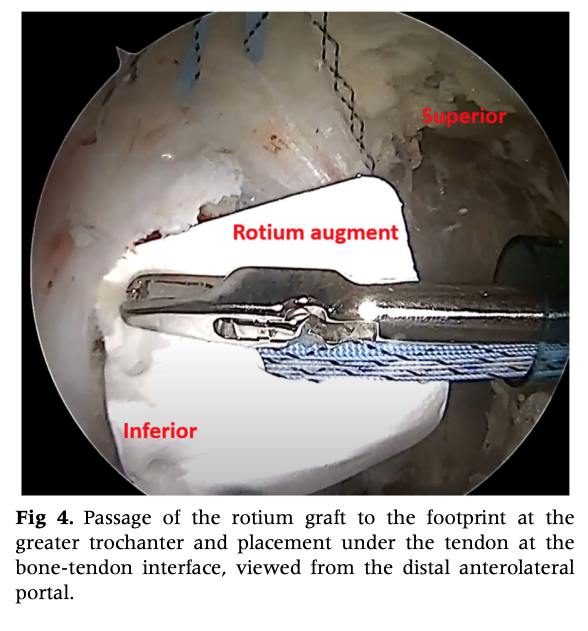
A New Era in Hip Tendon Repair: Biologic Augmentation with ROTIUM Greater trochanteric pain syndrome (GTPS) has long challenged surgeons with complex pathology and variable healing outcomes. A new concept for augmentation strategy recently published technique by Dr. Jovan Laskovski in Arthroscopy Techniques demonstrates endoscopic gluteus medius and minimus repair using the ROTIUM® Bioresorbable Wick with a a structural dermal allograft. Dr. Laskovski, a well-recognized orthopedic surgeon in Akron, OH, has previously utilized ROTIUM in a variety of tendon repair procedures. His work continues to expand the boundaries of biologic healing by adapting proven scaffolding strategies from rotator cuff repairs to hip applications. Technique Overview This particular “biologic sandwich” technique integrates two layers of biologic support: ROTIUM Surgical Technique Prepare ROTIUM with a hole and load it over the repair sutures. Shuttle it down the working cannula and position at the tendon-bone interface beneath the gluteus tendons.Retrieve sutures and tie to secure the scaffold in place prior to graft augmentation. Repair the tendon and compress to the footprint. A structural graft, such as the acellular dermal allograft, may be used as on onlay. This type of “sandwich” technique ensures that the ROTIUM scaffold directly supports biologic healing where it is needed most at the site of tendon-bone integration. Clinical Rationale Gluteus medius and minimus tears are biomechanically and biologically similar to rotator cuff tears. The tendon-bone junction in the hip, like in shoulder repairs, frequently presents biological challenges, especially in chronic and revision cases. Studies have shown that scaffolds such as ROTIUM enhance tissue remodeling and improve load-bearing integration at the repair site. This technique adapts those benefits to the weight-bearing demands of the hip. Efficiency Without Trade-Offs Broader Impact: Expanding Indications This publication reinforces a major milestone for Atreon Orthopedics: ROTIUM is now cleared for use across a wide range of tendon repairs beyond the shoulder, including hip, knee, elbow, hand, foot, and ankle. With growing adoption, this platform is redefining tendon healing with seamless integration into both open and endoscopic workflows. Why it matters: Surgeons now have a versatile, biologically active and fully resorbable scaffold to tailor for complex tendon repairs, offering new options for patients with poor tissue quality or high retear risk. Internal Links External References
Redefining Rotator Cuff Augmentation: How BioCharge® and ROTIUM® Offer a New and Efficient Approach
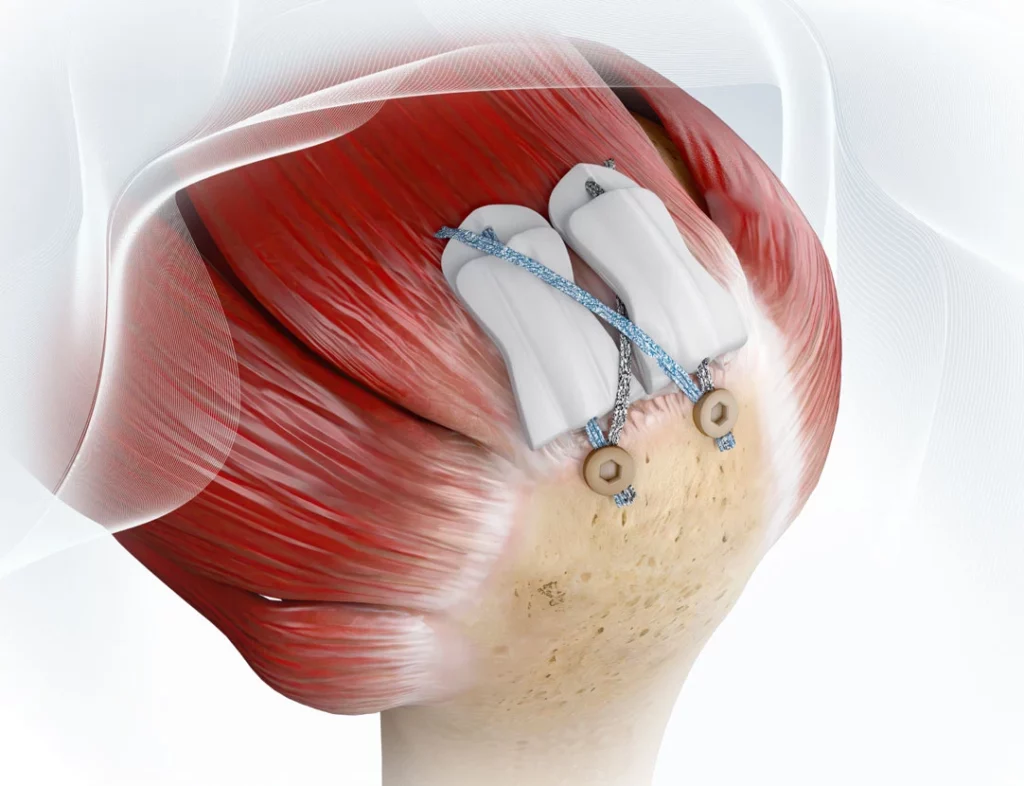
BoneZone’s coverage of scaffold augmentation in rotator cuff surgery highlights key findings from a study that evaluated ROTIUM® Bioresorbable Wick, Atreon’s synthetic tendon-to-bone scaffold.
See You in Nashville 🤠: Atreon Ortho at AOSSM 2025 + Exclusive OIC Networking Mixer
Atreon Orthopedics is exhibiting at AOSSM 2025 in Nashville (July 10–12) and co-hosting the OIC networking mixer with fellow innovators. Join us at booth 704 and RSVP now.
Atreon Orthopedics at ASES Annual Meeting 2025
The American Shoulder and Elbow Surgeons (ASES) 2025 Annual Meeting is scheduled for October 15–18, 2025, at the Gaylord Pacific Resort & Convention Center in Chula Vista (San Diego), California.
Atreon Orthopedics at OSET 2025
The Orthopaedic Summit: Evolving Techniques (OSET) 2025 is scheduled for September 18–21, 2025, at the Fontainebleau Las Vegas.
Atreon Orthopedics at AOFAS 2025
The American Orthopaedic Foot & Ankle Society (AOFAS) Annual Meeting 2025 is scheduled for September 10–13 at the Savannah Convention Center in Savannah, Georgia.
Atreon Orthopedics at AOSSM 2025
The American Orthopaedic Society for Sports Medicine (AOSSM) 2025 Annual Meeting is scheduled for July 10–13, 2025, at the Music City Center in Nashville, Tennessee.
Atreon Orthopedics at ASES Foundation Week 2025
The ASES Foundation’s 2025 National Shoulder & Elbow Week, themed “LIFT UP,” took place from May 12 to 17, 2025, across eight U.S. cities.
Atreon Orthopedics at AANA 2025

The 2025 Annual Meeting of the Arthroscopy Association of North America (AANA25) is scheduled for May 8–10, 2025, at the Washington Hilton in Washington, D.C.